Chevy Steering Angle Read Zero Point Calibration
Measuring the steering wheel position angle and rate of plough, which are critical for electronic stability control (ESC) systems, is the chore of the steering bending sensor (SAS). The scan tool volition typically display the information in degrees.
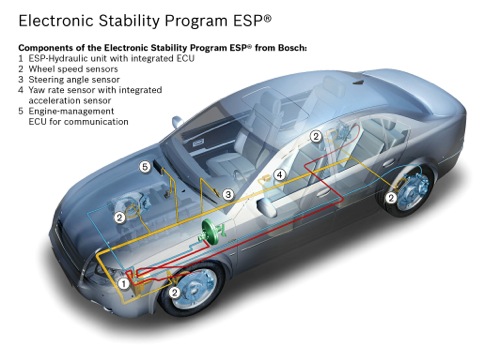
The SAS is typically a function of a sensor cluster in the steering column. The cluster will e'er take more i steering position sensor; some sensor clusters have three sensors for redundancy and to confirm the data. It is of import for the ABS/ESC module to receive ii signals to confirm the steering bike'southward position. These signals oftentimes are out of phase with each other.
Click Here to Read More
Analog SAS
Analog SASs are similar to throttle positions sensors. SASs are wired with a v-volt reference, chassis basis and signal output. To test the SAS, you have to dorsum probe a connector that is typically under the steering column.
As the steering wheel is turned 360 degrees, the SAS produces a indicate that toggles between 0 and 5 volts. As the wheel is turned lock-to-lock, the voltage will reach 5 volts three times and 0 volts three times.
Oft, other wires for the torque sensor for the electric ability steering get to the SAS sensor cluster. With meters connected to the signal wires for the 2 SAS sensors and their commons connected to the footing, information technology is possible to observe the 0- to 5-volt signal and how the signals are out of phase for the sensors.
With the wheels directly alee, 1 sensor reads 2.viii volts and the other 0.4 volts. If the voltages were the same, it could be a sign the point wires were shorted together.
With the wheel turned fully to the right, the voltages do not match, which is perfectly normal.
On nearly vehicles, turning to the correct creates a positive voltage and turning to the left creates a negative voltage. Only, some cars are opposite. The labscope pattern shows the signal traces from the 2 sensors on top of each other. This tin be helpful when comparing the signals and if one is flat lining.
Digital SAS
A digital SAS is often chosen a "contactless sensor." This type of sensor uses LED lite, a wheel that acts as a shutter and an optic sensor that measures interruption in the light, only similar a benefactor on a Chevy LE1 V8.
The signal for these types of sensors is a digital square-wave signal. The frequency of the voltage changes depending on the speed the wheel is turning.
The sensor clusters for these sensors often contain a third sensor just to mensurate if the bicycle is centered. With the wheel straight, the voltage is shut to 0 volts. When the steering wheel is moved off middle, the voltage goes loftier.
Can Autobus Module SAS
Some SAS clusters and sensor modules connect to a controller area network (CAN) double-decker. The SAS module tin can connect directly to the ABS/ESC module on a CAN jitney or it can be function of the overall CAN in a loop that connects diverse modules in the vehicle.
A Tin bus is a high-speed series data network that communicates in binary language to other modules or nodes. When you connect your browse tool to a vehicle, it becomes a node on a network. High-speed Can buses, like GM LAN, use simply 2 wires per module or node to communicate vast amounts of information.
This ways that a node, like an SAS module, has to have the ability to interpret and create signals that can be understood by other modules on the charabanc.
Testing Direct-Type Tin can SAS
The best manner to test modules on a high-speed CAN bus is with a scan tool. Well-nigh tools are able to look at the data direct. But, some scan tools may not be able to look at the information stream directly for an SAS due to software issues with the tool.
If you are in this state of affairs, information technology is possible to observe how the actuation of a sensor, switch or component can change action on the bus.
All Can motorcoach modules have power and two loftier-speed CAN wires. Ane wire toggles the voltage betwixt one.5 and 2.5 volts and the other wire will toggle the voltages between 2.five and 3.5 volts. Serial data buses toggle the voltages on the network to produce the 1s and 0s of binary language. This toggling of the voltages communicates information and commands.
If you connect your telescopic between chassis ground and the passenger vehicle wires and look at voltage, it is possible to see packets of data being communicated on the passenger vehicle.
On a straight-blazon SAS CAN sensor, you can run into the sensors communicating with ABS/ESC module as the wheel is turned. It is impossible to tell what is being communicated, but it is possible to see they are communicating.
On some vehicles, the SAS sensor cluster is part of a module that may include switches for the turn signals, steering wheel audio controls and wipers. This module might have multiple CAN lines coming out of it. Oft, the SAS cluster cannot be replaced on its own. Information technology might require replacement of the entire unit.
Resetting SAS
Many vehicles require the SAS be reset or recalibrated after an alignment is performed or parts in the steering organization are replaced. There are three types of reset procedures: systems that self calibrate on their own, vehicles that require specific wires or buttons exist pressed, or systems that require recalibration with a scan tool.
Even if the SAS is out of calibration, most vehicles have ways of sensing if information technology is traveling in a straight line. If the bending is far enough out of range, it might ready a trouble lawmaking and disable the ESC system.
Self-Calibration
On some Chrysler vehicles, recalibrating the sensor later on an alignment or if the bombardment has died, is just a matter of turning the wheels lock to lock, center the wheel and cycle the key. This "motorcar acquire" is becoming more common on newer vehicles.
Scan Tool SAS Reset
At that place are many options for scan tools to reset SASs. Some tools are fifty-fifty integrated into an alignment organisation. But, most tools recommend that the calibration be performed on a level surface. Also, it is a good idea to perform a lock-to-lock turn to complete the calibration.
While performing the zero-point calibration on Toyota vehicles, do non tilt, move or milkshake the vehicle. The vehicle must remain in a stationary condition throughout the unabridged process. Exist sure to perform the procedure on a level surface with an inclination of less than 1%.
1. If the vehicle is equipped with an A/T, ensure that the shift lever is in the "P" range and the parking brake is practical. If the vehicle is equipped with a M/T, ensure that the parking restriction is practical.
2. Turn the ignition switch ON.
3. Using a jumper wire in terminals 4 and 12 of the DLC, echo a bicycle of brusk and open between terminals four times or more within eight seconds.
iv. Verify that the VSC indicator light is lit indicating the recorded cipher bespeak is erased.
5. Turn the ignition switch off.
half dozen. Be sure the jumper wire is disconnected.
7. Turn the ignition switch on.
8. Cheque that the VSC warning light goes off about xv seconds after the ignition switch is turned on.
9. After ensuring that the VSC warning calorie-free remains off for two seconds, turn the ignition switch off.
x. Connect terminals 4 and 12 of DLC using SST 09843-18040.
11. Turn the ignition switch on.
12. Later on turning the ignition switch on, check that the VSC alarm calorie-free is lit for about 4 seconds and so starts quick blinking at 0.13 second intervals.
thirteen. Afterwards ensuring the blinking of the VSC alarm light for two seconds, turn the ignition switch off.
14. Remove the SST from terminals iv and 12 of DLC.
xv. Bulldoze the vehicle for at least 5 minutes to confirm null-point scale is complete.
If viewing the scan tool later the repair, the SAS may remain at 1150 until the vehicle reaches 28 mph. This is a normal condition until the learned values of the steering angle have been achieved.
Source: https://www.tirereview.com/steering-angle-sensor-diagnostics/

Postar um comentário for "Chevy Steering Angle Read Zero Point Calibration"